
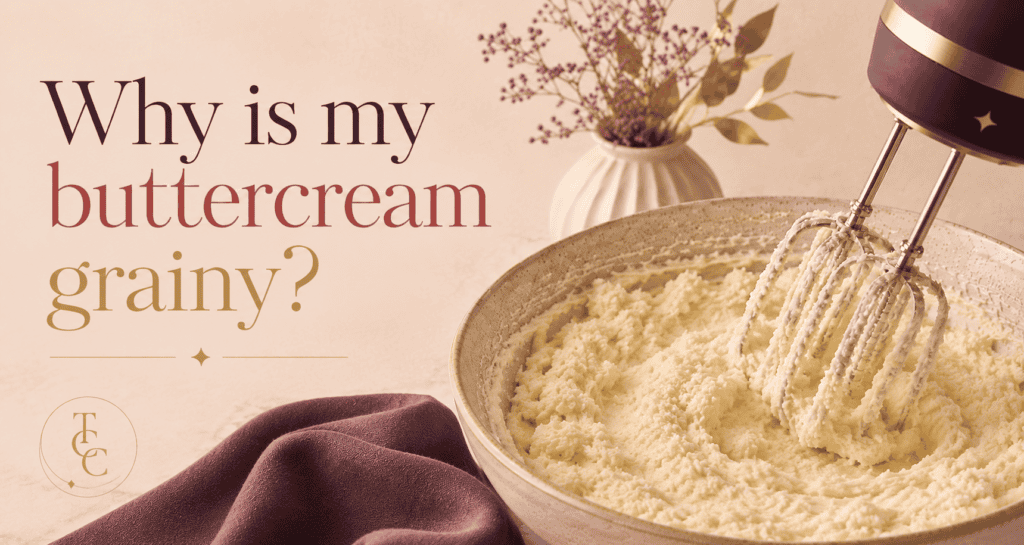
Grainy buttercream is almost always down to undissolved icing sugar, or sugar crystals that haven’t fully broken down when you were mixing. The fix is usually more mixing time – keep beating on medium-high speed for 3-5 extra minutes, and you should end up with a lovely, velvety buttercream with all the sugar dissolved.
This guide covers classic American buttercream (butter and icing sugar) – meringue-based buttercreams can also turn grainy, but for a different reason (undissolved granulated sugar in the meringue base), which I’ll cover separately.
Why Buttercream Turns Grainy
Unlike splitting or runniness, grainy buttercream isn’t a structural problem – it’s about the sugar in the mix not being properly broken down. Common causes:
- Icing sugar that hasn’t fully dissolved. Definitely the most common cause of grainy buttercream. Icing sugar needs proper mixing time to dissolve into the butter, and rushing this step leaves a gritty texture to your buttercream.
- Using granulated or caster sugar by mistake. These sugars are too coarse and don’t dissolve the same way icing sugar does. No matter how much you mix, they WILL leave a noticeably gritty texture. Sorry, no sugar swapping! Pop to the shop and get icing sugar only.
- Lumpy or un-sieved icing sugar. Yes, it’s a pain, but you MUST sieve your icing sugar. Icing sugar gets clumpy, especially if it’s been stored for a while and then un-sieved lumps mix in as grainy bits rather than dissolving smoothly.
- Under-mixing. Sometimes it’s just a case of mixing more. The icing sugar needs a little time to dissolve into the butter. Sometimes even though it looks like they’ve combined, the ingredients need a couple more minutes of mixing to give you a smooth, velvety buttercream texture.
The Fix, Step by Step
- Keep mixing, even longer than you think you need to. Put your mixer on medium-high speed and let it run for 3-5 extra minutes. Icing sugar takes longer to fully dissolve than people assume, and a lot of “grainy” buttercream jus hasn’t had enough time to dissolve.
- Always sieve your icing sugar. If you didn’t sieve it the first time, this could be your culprit. Next batch, sieve before adding to catch any lumps before they go in.
- As a last resort, add a small amount of liquid. A teaspoon of milk or cream can sometimes help dissolve stubborn sugar crystals that mixing alone hasn’t fully broken down – though this should be a last resort rather than a first step, since it can affect consistency.
How to Avoid It Next Time
- Always sieve your icing sugar before adding it, even if it looks fine in the packet
- Make sure you’re using icing sugar, not caster or granulated sugar
- Give your mixer enough time – don’t stop as soon as it looks combined; keep going until it’s velvety smooth
- Keep your icing sugar in a sealed container to help stop it going clumpy
But what if you’ve got other buttercream problems? Find out how to fix runny buttercream, or even how to save split buttercream with my other posts.
Frequently Asked Questions
Is grainy buttercream safe to eat?
Absolutely! The grainy texture is a consistency issue, not a food safety one. It’s just a bit less pleasant to eat and pipe with.
Can I fix grainy buttercream after it’s already on the cake?
Unfortunately not. The fix always involves mixing your buttercream, so once it’s on the cake it’s too late.
Does the brand of icing sugar make a difference?
Some brands are more finely milled than others, which can change how easily they dissolve. And some use anti-caking agents that can affect their texture too. If you’re always getting graininess with the same brand, it might be worth trying a different one. I personally love Silver Spoon icing sugar, but try some and see which one works best for you.